An alternative history: a canny idea for a folk musician. When reinterpretation is your stock in trade, why not reinterpret your own work? Jim Moray’s Beflean – see the interview below for an explanation of that term – does just that, with a mighty crew of guests adding fresh perspectives and sounds.
Apart from anything else, the record is a reminder of an exemplary 21 years of music – straightforwardly, there’s not a single track here that’s anything less than excellent. Songs are lifted largely from Moray’s solo efforts, with the swaggering Tyne of Harrow (featuring Tom Moore, Archie Churchill-Moss and Cormac Byrne) coming from False Lights, his collaboration with Sam Carter. There’s a couple of tracks with which we’re not familiar, too.

Of the stuff we do know, Lemady is (as you’d expect) a more technologically accomplished version of his tentative take on 2001’s I Am Jim Moray EP, while retaining its plaintive romance, while Fair Margaret and Sweet William is balladry at its most thrilling, now with extra added zip. Sounds of Earth, Moray’s songwriting calling card, feels confident and insightful.
Meanwhile, Lord Douglas (Moray’s trad calling card, perhaps) gets haunting vocals from Angeline Morrison, and mournful slide guitar from BJ Cole. Jon Boden provides a vivacious fiddle line to a stripped-back, insistent Hind Etin and the beautiful duduk and ney – woodwind instruments found often in Middle Eastern music – are relevantly added to a fresh version of Lord Bateman, played by Murat Savaş.
Moray’s sense of drama pervades – on Dog and Gun particularly, while Beflean’s version of Long Lankin is one of the more chilling takes we’ve heard in a while. The album reflects an engaged, thoughtful artist – someone for whom a song isn’t necessarily ‘finished’ simply because it’s been recorded. It’ll have you going back to the Jim Moray albums you already own, and looking forwards to the next surely fascinating phase of his career.
Jim Moray was kind and patient enough to answer a mixture of predictable and less predictable questions for Folk Witness.
Folk Witness: Thanks for speaking to us! Brace yourself for the most obvious questions up top: Where did you come across the term ‘Beflean’? And why is it the name for your alternative history?
Jim Moray: Beflean is old English for “to strip to the bone” – literally to flay. That was the original plan for the album – to make some stripped down versions of some of the songs that are more in keeping with the solo gigs that I’ve played in the last few years. It didn’t quite work out that way, for various reasons, but it’s still relevant as a title.
And – yep – when you decided to re-record some of your songs, how did you decide which ones to include?
At first I thought I might just make a four-track EP in Abbey Road, maybe four of the Child ballads or four songs on a theme, but then I increasingly felt like that would make it too narrow. There are some that I just wanted another go at. Sounds of Earth and Lord Douglas haven’t changed much from their original arrangements but I’ve now played and sung them a lot more and I feel like I’ve got better at it. They deserved to be recorded in a better studio than the loft room I was using when those albums were first made. Then I suppose there’s songs that never really got much attention. Dog and Gun (from the Jim Moray album in 2006) wasn’t one I ever played live because some of the people I was working with at the time really hated it! Similarly, Hind Etin had a tune that I was really proud of and I really liked the recorded version but by the time it was released I wasn’t playing live with an electric band as much so it got left behind.
Were there any songs that jumped out as being ones to definitely not include? Songs that felt unrevistable, for whatever reason?
One of the constraints that was retained from that original concept was that there are no drums on the album, and I suppose the process of making it has shown me how important those parts of the arrangements are to whatever it is that I do. So there was little point going back to Leaving Australia (from Low Culture) because I felt like I’d got it right the first time around. In that way it’s arguable that I didn’t need to do Fair Margaret and Sweet William (from Upcetera) again, but I wanted to have a good distribution of songs from across the albums, and also have enough things with more energy to offset the eight-minute ballads. I am really pleased with this album, but I am excited to get back to making music without the self-imposed limitations now.
With the traditional songs – Long Lankin, say – to what extent are you revisiting your arrangement of the song, versus looking at it afresh? I’d imagine your new collaborators brought something new, too…
Long Lankin was one that I was particularly keen to re-record because the original album version isn’t very good [FW here: it in fact is good, though we’d agree the Beflean version is even better]. I’d played it a lot more since that recording (for In Modern History in 2010) and it’s much better in a fingerpicking guitar form. I’m very proud of the tune and set of lyrics though, so I wanted to get a good version of it available. I’d say that, in general, the re-evaluation of the arrangements has happened over time rather than specifically for this album.
The big undertaking was Lord Bateman, which is a completely different version from the recording on Sweet England. The mix and production of the original was a lot of people’s introduction to me, and opened a lot of doors, but the tune and words that I used were taken from Chris Wood’s singing of the song. I felt like I needed to completely start again, with the benefit of everything I’ve learned in the meantime, so that’s almost like a new track. Having Murat play Turkish duduk and ney represented that clean break too – having another tradition from elsewhere bring something new to it.
Speaking of collaborators, how did the process of choosing them unfold? Did anyone surprise you or contribute in an unexpected way?
I’d love to say that they did, but in truth I picked the guests for a specific thing that they do that I wanted to have on the album. I love Jon Boden’s fiddle playing on the first few Spiers & Boden albums, and I think it gets overlooked because he was the frontman in Bellowhead (and, I suppose because he was standing next to Sam Sweeney there!). I really wanted him to do the thing that I loved when I first met him. And both Archie and Cohen (Braithwaite-Kilcoyne] are so technically accomplished on their instruments that I knew they could cope with more complex chords or key changes rather than butting up against limitations.
Do you like The Smiths?
That’s a very complex question to answer. The Smiths were incredibly influential on my teenage years, not just musically but in shaping my self-identity. I’m sure that’s true for lots of people who were interested in guitars and not entirely clicking with traditional masculinity. There’s other things from my formative years that have been tainted recently (I’m thinking of Father Ted) but I think my way through is in thinking of it as Johnny Marr’s band.
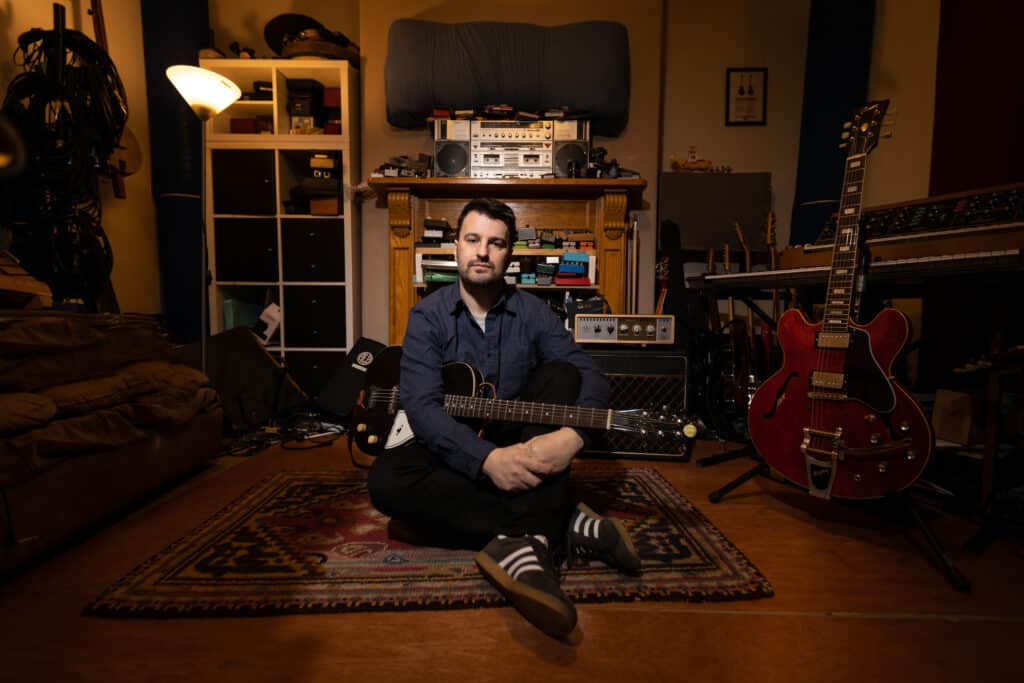 Is Abbey Road as special a place to record as we imagine it is? Did its status, or magic, inform the sessions?
It is. But really because of the infrastructure and staff that work there. It does feel special to sing into the mic that John Lennon or Kate Bush sang into, but if it were to break you could call for another one which would turn up within minutes and you wouldn’t lose your flow. Most studios don’t have the resources to work that way. The other magic element of Abbey Road is that everyone working there on a given day uses the same canteen (the one where Pink Floyd or The Beatles were photographed) so there’s a very egalitarian feeling to joining the queue with the people from the orchestra recording a film soundtrack in Studio 1, the indie guitar band recording in Studio 2 etc. Knowing that you’re in a serious place that people come to to make the best work they can is very inspiring.
I saw an interview, some time ago, where you described Low Culture as a ‘red and white’ album – not just in terms of its artwork, you were saying the artwork was appropriate because the album was already red and white. It makes sense, somehow. What colour is Beflean?
I’ve always found it helpful to have a title and cover complete before the music is finished. My least successful albums are probably the ones where I didn’t have those ideas until late in the process. But for Low Culture, Skulk and Upcetera I had the cover printed out and stuck on the wall by my desk for six months before they were finished. Beflean is dark red, but it could also have been bottle green or purple. I don’t have synaesthesia in a visual sense – something much harder to explain about sounds having surface textures that you can feel – but I do associate the colours with feelings, and then those feelings with sounds.
We’ve checked the archives and absolutely cannot believe we haven’t asked you this before… what’s your favourite sandwich?
This is the sort of question that I’d probably have deflected in the past, or given some nonsense answer to avoid giving anything mundane away. Plus, as people who were around the folk scene in the mid-2000s might have worked out, I didn’t really like food then and tried to avoid it as a rule. But it’s cheese and crisps (preferably salt and vinegar Pringles).
Beflean: An Alternative History 2002-2023 is out now. Jim Moray is on tour in 2024, see here for dates. Photos by Robin Clewley.
Be First to Comment